Red Oak Rough Lumber — Appalachian, Any Quantity, Priced per Board Foot
Starting at $5.20 per board foot — 4/4 rough sawn Red Oak, priced live as you configure
Buy Red Oak lumber by the board foot. Appalachian kiln-dried Red Oak in 4/4, 8/4, and 10/4. Rough sawn, S2S, or S4S. Any quantity, factory direct pricing.
Random-width, 8 ft rough sawn boards sized to the board feet you enter.
Estate Millwork sources Appalachian Red Oak from select mills for our door and shutter production. Buy that same kiln-dried Red Oak by the board foot — select thickness and milling, enter the quantity you need, and add to cart.
Choose Rough Sawn for shop stock you'll mill yourself. Choose S4S for boards surfaced to 150-grit and ready to use. Choose S2S for face-surfaced material you'll joint yourself.
About Our Red Oak
- Appalachian origin — tighter grain, superior stability
- Kiln-dried to 6–8% moisture content
- #1 Common and better grade
- Available 4/4 through 10/4 thickness
- Random widths and lengths typical of the species
What Builders Make from Red Oak
- Furniture and cabinetry — the American shop standard: tables, casework and face frames that take stain evenly
- Flooring — the benchmark domestic hardwood floor, Janka 1,290
- Interior doors and trim — stiles, rails, panels and casing
- Mission and Craftsman furniture — quartersawn Red Oak shows the classic ray fleck
- Mouldings and stair parts — treads, rails, balusters and crown
Grade, Thickness and Board-Foot Pricing
Our Red Oak is Appalachian #1 Common and better, kiln-dried to 6–8%, and sold by the board foot — one board foot is 144 cubic inches (a 12×12×1″ board). We stock 4/4 through 8/4; quartersawn and rift-sawn stock, extra-wide boards, and truckload quantities are quoted on request through the form below.
Call 412.641.0177 with questions or custom quantity requests.
- Red Oak Finished Boards — Cut to exact width and length, per piece
- Red Oak Bulk — 500 BF minimum, LTL and truckload
- All Species Rough Lumber — 16 species available
- White Oak Lumber — Closed pore, rot-resistant, exterior grade
- Walnut Lumber — American Black Walnut, no stain needed
- Cherry Lumber — Appalachian Black Cherry, patinas with light
- Maple Lumber — Maple, Janka 1,450
- Mahogany Lumber — Genuine mahogany, stable and rot-resistant
- Sapele Lumber — African ribbon-stripe, Janka 1,410
- Teak Lumber — Plantation Teak, the marine standard
- Cypress Lumber — Southern Cypress, naturally rot-resistant
- Cedar Lumber — Spanish Cedar and Western Red Cedar
Red Oak at a Glance
The technical properties builders, woodworkers and specifiers ask about most, for American Red Oak (Quercus rubra).
| Botanical name | Quercus rubra — family Fagaceae, the beech & oak family |
|---|---|
| Also known as | Northern red oak, American red oak, common red oak, gray oak |
| Where it grows | Native across the eastern United States and southeastern Canada; the Appalachian stock we buy is prized for tighter, more even grain. The most abundant and most-harvested hardwood in North America |
| Average dried weight | ~44 lbs/ft³ (700 kg/m³) — medium-heavy |
| Specific gravity | 0.56 basic / 0.63 at 12% MC |
| Janka hardness | ~1,220 lbf (5,430 N) — hard and wear-resistant, the benchmark against which other domestic hardwoods are compared |
| Rot & insect resistance | Non-durable — the open, porous grain wicks water, so Red Oak is an interior wood and is not recommended for exterior or wet applications (this is the key difference from White Oak, whose closed pores make it rot-resistant) |
| Grain & texture | Straight-grained with a coarse, open, porous texture; the large pores take stain readily and give Red Oak its recognizable strong grain pattern. Quartersawn faces show a dramatic ray fleck |
| Color | Light-to-medium reddish-brown heartwood with a warm pinkish cast; near-white sapwood |
| Machinability | Machines, glues, nails and screws well; responds cleanly to hand and power tools. Its density means sharp tooling gives the best edges |
| Gluing & finishing | Glues well and takes stain and clear finishes evenly and predictably — one of the easiest domestic hardwoods to finish, which is a large part of why it is the shop standard |
| Paintability | Paints well over primer, though the coarse open grain telegraphs through unless it is grain-filled first; most builders stain or clear-finish it to show the figure |
| Stability | Moderate — it moves more seasonally than White Oak or Mahogany, so interior stock should be acclimated and allowed for; excellent once installed indoors |
| Sustainability | Abundant and responsibly harvested throughout North American hardwood forests, where the standing volume of red oak is growing faster than it is cut — one of the most sustainable hardwood choices available |
The Story of Red Oak
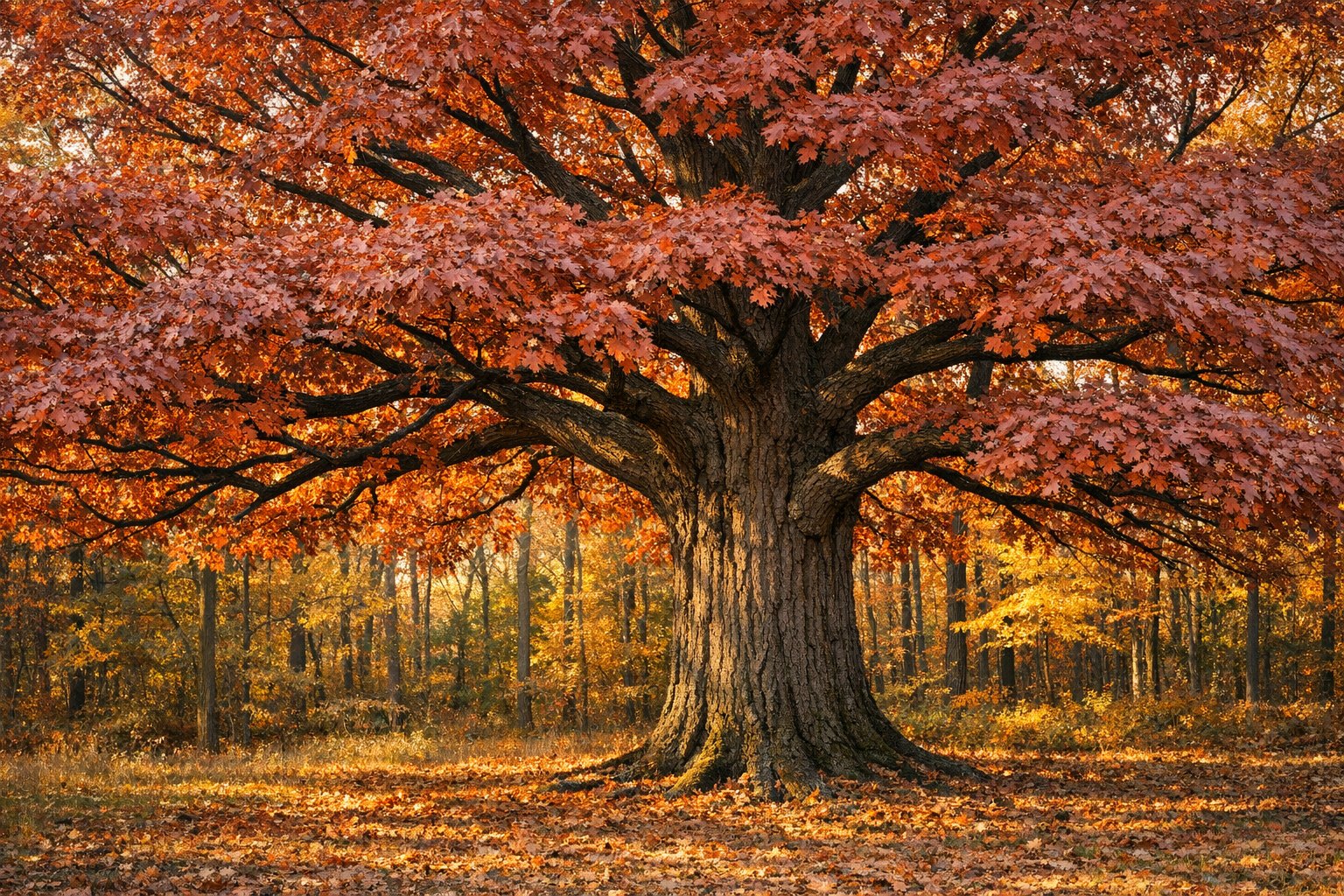
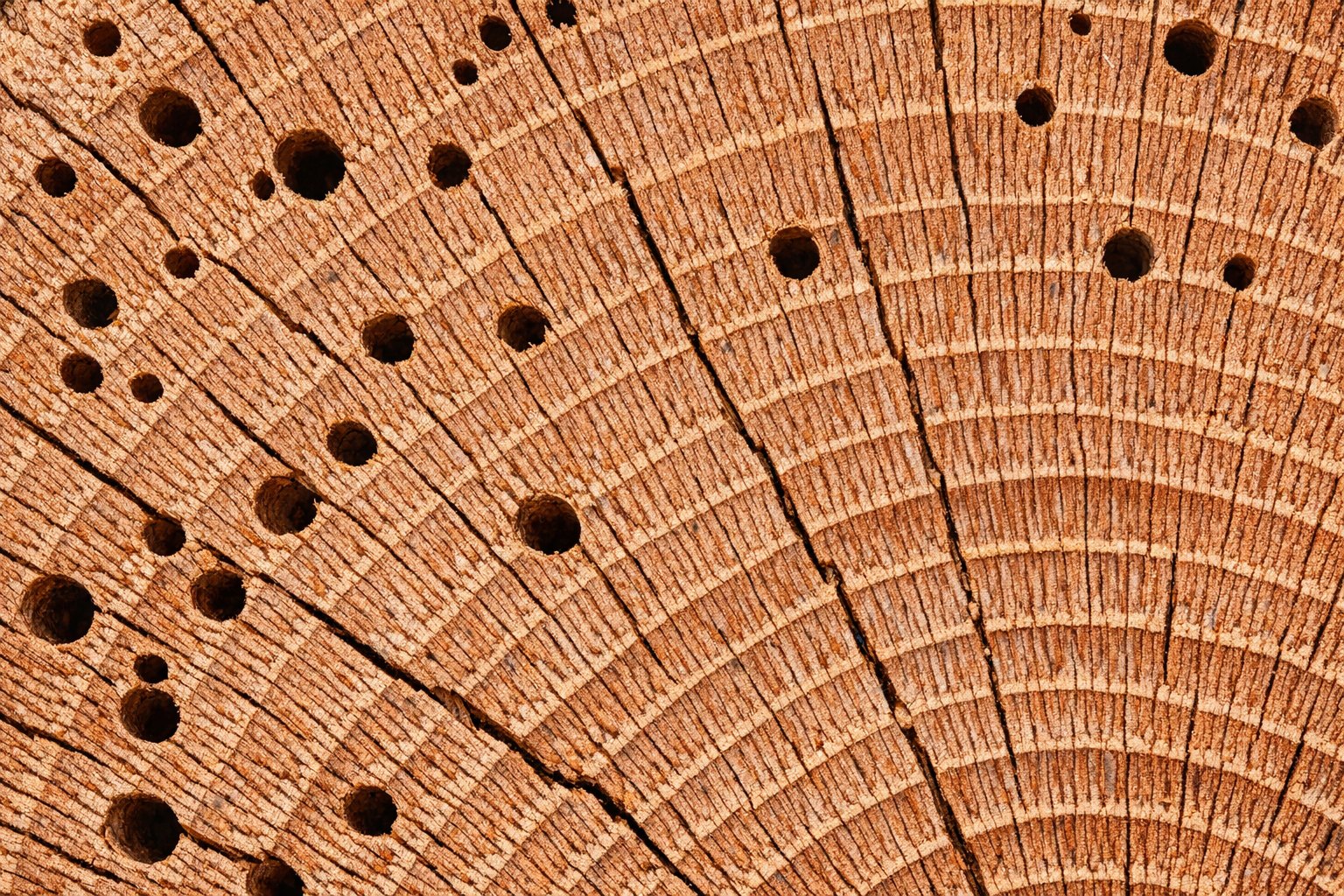
Red Oak is Quercus rubra, a fast-growing broadleaf tree of the beech and oak family (Fagaceae) native to the eastern United States and southeastern Canada. Reaching 90 feet or more with a broad crown and the deeply lobed, bristle-tipped leaves that turn brilliant red in autumn, it is the most common and most widely cut hardwood on the continent — and the wood most Americans picture when they picture "oak."
The American shop standard
For the better part of a century Red Oak has been the default hardwood of the North American woodshop. It is plentiful, affordable and consistent; it stains evenly; and its strong, open grain reads unmistakably as oak. Post-war housing filled with red oak floors, trim, doors and cabinets, and the Mission and Arts-and-Crafts movements made a signature of its quartersawn ray fleck. When a plan simply calls for "oak," it almost always means red oak.
What it is made into today
Red Oak is the benchmark domestic flooring wood, and it goes into furniture and cabinetry, interior doors and trim, mouldings, stair parts, face frames and casework — the same interior door and shutter parts we mill in our own shop. Its one boundary is water: because its pores are open, Red Oak stays indoors. For an exterior door or a wet application, White Oak is the closed-pore cousin to reach for.
Working with it
At about 1,220 on the Janka scale Red Oak is genuinely hard and wears well, yet it machines, glues and fastens without drama and finishes more predictably than almost any other hardwood. The coarse grain is the thing to plan around: it takes stain beautifully but wants grain filler under a fully smooth painted or high-gloss finish, and sharp tooling keeps the large pores from tearing. Acclimate the stock before you build — like all oak it moves with the seasons.
Red Oak — Common Questions
How is Red Oak lumber sold and priced?
What do people build with Red Oak?
How hard is Red Oak and is it easy to work?
Can Red Oak be used outdoors or in wet areas?
How does Red Oak finish, and can it be painted?
How stable is Red Oak — will it move?
Where does Red Oak grow and is it sustainable?
What is the difference between Red Oak and White Oak?
Is quartersawn Red Oak available?
Built to order in Red Oak
The same Red Oak we sell here go into our custom millwork
Estate Millwork mills this stock into finished, made-to-size doors, shutters, and cabinet doors — priced to your exact dimensions and shipped nationwide. Start with the product you need:
Custom Wood Doors From Our Hardwoods
The same kiln-dried stock on this page is what we mill into custom solid-wood doors — built to your exact opening, in any species. Browse by type:
- Interior Doors — solid-wood passage, closet and panel doors, any species
- Entry Doors — exterior-grade front and entry doors, built to the rough opening
- Louvered Doors — fixed or operable louver doors, cabinet height to full height
- Oak Doors — Red and White Oak, our most-ordered door species
- All Custom Doors — every style, priced live in the door designer
Custom & Bulk Quotes
Get a Custom Red Oak Lumber Quote
Truckload bulk, surfaced (S2S / S4S) stock, extra-wide or figured boards, or a species that isn’t on the calculator — tell us what you need and we’ll price it, usually within 1–2 business days.
Prefer to talk it through? Call 412.641.0177.