
Hardwood Lumber Sizes and Buying Guides: A Complete Guide
Published: September 12, 2022
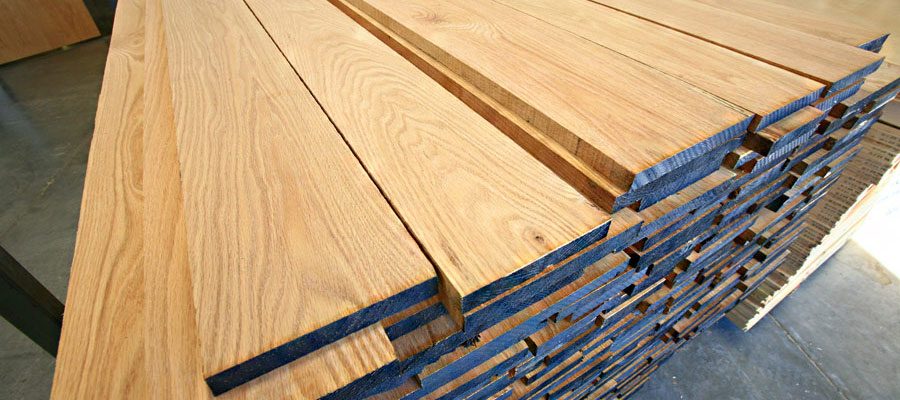
With nominal dimensions being widely used when selling softwoods, some large retailers have extended the practice to hardwood boards as well. Your local home center probably stocks a few species of hardwoods, like oak, maple and cherry. These boards generally are planed to 3/4-inch thick, jointed flat on the edges and cut to standard widths and lengths. Within the lumber industry, hardwood lumber like this is categorized as "S4S", which stands for Surfaced Four Sides. All of this surface preparation at the mill translates to higher prices for you, but it may make the most sense to buy S4S lumber if you don't own a thickness planer or jointer to prepare board surfaces yourself.
To find specialty or thicker hardwoods, you'll need to expand your wood shopping outside the big box stores. A good lumber supplier will offer a wide selection of hardwoods in random widths and in an assortment of thicknesses and grades. In addition to S4S, you'll see S2S lumber which is planed smooth on two faces but the edges are rough, and rough sawn boards which are boards that are simply cut, dried and shipped to the lumberyard.
Shop Dimensional Hardwood Lumber
Because of the diversity of uses, hardwoods are typically sold in a much larger variety of thicknesses than standard 1x and 2x softwoods are sold by. This has led to a quartering system for determining lumber thickness, which allows you to buy hardwoods in 1/4-inch thickness increments from 3/4-inch on up.
Most yards offer popular hardwood species in three, four, five, six, eight, ten and even twelve quarter thicknesses which are read as 3/4, 4/4, 5/4, 6/4, 8/4, 10/4 and 12/4 on the label at the rack. These correspond to the rough pre-planed thicknesses of 3/4-inch, 1-inch, 1 1/4-inch, 1 1/2-inch, 2 inch, 2 1/2-inch and 3 inch.
Hardwood Surfacing Options
If the extent of your hardwood needs amounts to only an occasional project, buy S4S boards at the yard. They'll come planed on both faces and jointed flat on both edges, ready for breaking down into parts for your project.
If you have access to a jointer, consider buying S2S lumber, which still has rough edges but the faces are planed smooth. The most economical hardwood comes rough sawn to the lumberyard and will require you to do all of the surface preparation yourself. If you don't own a planer some lumber yards will plane your lumber for a nominal fee.
Hardwood Lumber Grades
Hardwood lumber is graded using a different classification system than softwoods. Grades are based on the percentage of clear face cuts that can be made around a board's defects knots, splits, pitch pockets, and so forth. From highest grade to lowest (most allowable defects). The grades are:
| Grade | Percentage of Clear Cuts |
|---|---|
| FAS (Firsts & Seconds) | 83 1/3% |
| Select | 83 1/3% |
| No. 1 Common | 66 1/3% |
| No. 2A & 2B Common | 50% |
| No. 3A Common | 33 1/3% |
| No. 3B Common | 25% |
Choose the lumber grade that best suits the needs of your project and your budget. It could be that a Common grade will provide all the knot-free lumber you need at a significant savings over FAS.
Build your new Custom Millwork and get a Free Instant Quote Today
Our state of the art designers allow you to design and build completely customized millwork to fit your exact needs.
Questions or concerns contact us contact us or via 412.641.0177 .
Build an Instant QuoteSelecting Quality Hardwood Lumber for Your Project
Whether you are building furniture, trimming out a room, or crafting custom millwork, the quality of your lumber determines the quality of the finished product. Estate Millwork supplies kiln-dried dimensional lumber in species selected specifically for architectural and furniture-grade applications. Kiln drying reduces moisture content to eight to twelve percent, which minimizes warping, cupping, and cracking after installation.
Mahogany is the flagship lumber species for exterior applications. Its interlocking grain pattern resists splitting, its natural oils deter insects and rot, and it machines to a glass-smooth finish. For exterior trim, deck railings, and boat building, Mahogany delivers performance that justifies its premium price. Spanish Cedar shares Mahogany's workability and weather resistance at a lighter weight, making it preferred for large-panel applications like shutters and doors.
Domestic hardwoods cover the full spectrum of interior projects. Red Oak and White Oak provide strength and visible grain for flooring, stairs, and paneling. Cherry and Walnut are prized for furniture and cabinetry where natural color and figure are the primary design elements. Maple is the hardest common domestic species, ideal for cutting boards, countertops, and high-wear surfaces. Poplar is the versatile utility player: easy to machine, stable, and affordable for painted trim and millwork.
Shop dimensional lumber by species:
Need Help?
Related Posts
Interior Cabinet Door Styles That Elevate Your Kitchen Or Bathroom
Published: November 12, 2025
Why Mortise & Tenon Joinery Still Matters in Millwork
Published: October 23, 2025
From Shaker To Raised Panel: Cabinet Door Styles That Transform Your Home
Published: October 08, 2025
How to Match Door & Shutter Styles for a Cohesive Home Design
Published: September 30, 2025
Choosing the Right Exterior Shutters: Louvered, Board & Batten, Bahama, and More
Published: September 25, 2025
The Warmth Of Wood: Barn Doors Tailored To Your Home
Published: September 09, 2025
Classic Style, Modern Strength: Custom Wooden French Doors
Published: September 03, 2025
Built By Hand, Designed To Last: Custom Wood Louvered Doors
Published: July 07, 2025
Flat Panel Shutters For Colonial, Craftsman, And Farmhouse Styles
Published: May 28, 2025
Bring Old-World Charm Home With Custom Wooden Louvered Shutters
Published: May 04, 2025