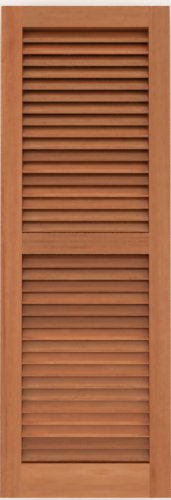
Exterior Wood Shutters - Notes on Quality
We are often asked how our exterior wood shutters are different. This article attempts to explain why our shutters cost only a little bit more, but look so much better and last so much longer. There is a summary table at the bottom of the article for your reference, but we hope the explanations help you to gain a better appreciation of the anatomy of a well built, Estate Millwork shutter.
Estate Grade
Estate Millwork Estate Grade exterior wood shutters are
manufactured from premium hardwoods such as Spanish Cedar, Teak, and
Mahogany and can be produced in any non-standard size, with many
options such as radius tops, custom sticking, and custom rail
and stile widths and placements.
The top grade of exterior wood shutters (and the only grade we manufacture) has
true mortise and tenon joinery, solid panels and louvers, does
not use finger jointed lumber, dowels or screws and is hand
assembled, hand clamped, and hand finished. All of our milling
and machining is performed in house for quality purposes, and we
are committed to green forest management.
Each hardwood exterior shutter is fabricated from wood that is precisely
dried to a 6% moisture content, and then carefully handled
throughout the production process. The harder a wood, and the
drier that it can be made, affect the long term stability of a
shutter. If wood is not carefully dried to the lowest optimal
moisture content -- it will constantly fight its environment to
try to either absorb or emit moisture, and as it does so, the
wood fibers distort and reform resulting in rack, bow and cupping
of components.
Premium Grade
Most of our competitors manufacture a premium grade of shutter or
lower. Their products do not make the Estate grade by virtue of
the lower quality of materials that are used. All Cedars are not
the same, and although we use a hardwood cedar, some of our
smaller competitors use Western Red Cedar, Incense Cedar or
Aromatic Cedar -- all soft woods.
Western Red Cedar is a soft wood that can only be dried to a
moisture content of 15%, and current production is largely of
"new-growth" immature trees in Canada. New-growth, wet woods from
a northern climate will not fare well anywhere, let alone in the
rough, hot humid environments found seasonally in most of the
United States. Tropical hardwoods are much better materials for
exterior millwork because they are a) harder, and b) can be
thoroughly dried to 6% moisture content.
It is surprising how many
manufactures actually charge more than Estate Millwork
does, for shutters built with a lower quality wood species.
In fact, to save money, many of the Western Red Cedar manufactures
are actually using a low grade
by-product cedar that they purchase from large mills that produce
flooring, trim and decking. We commend them, on an environmental
basis, on their use of
lumber that may otherwise go to the scrap heap, but their prices
do not reflect the discount that is warranted for the use of
sub-prime materials.
Standard Grade
Standard Grade shutters are usually only available in stock sizes, are
made from lower grade materials, and are typically assembled with
screws, pins, dowels or other hardware. Typically they come in
softwoods such as pine and Western Red Cedar which do not have the
strength or longevity of Mahogany or Spanish Cedar. The life of a
standard grade shutter is often less than five years, and they may
begin to fail in as little as three years.
Utility Grade
These bulk shutters are usually made in China or Mexico, if they
are made of wood at all. Oftentimes they are injected moulded
from Plastic or PVC, and are very flimsy, and need to literally
be screwed to the house because traditional shutter hardware will
not support them. They are most commonly found on trailers, and
low end residential and condos. They can not be trimmed,
painted, or refurbished, and tend to lose their original color
and to become brittle with prolonged exposure to sunlight.
Please, never put these on your home.
| Grade | Material | Price | Aesthetics | Joinery | Durability |
|---|---|---|---|---|---|
| Estate -
Solid Hard Wood. Mortise and Tenon joinery. | Spanish Cedar, Mahogany | $150 | 
|
|
|
| Premium -
Soft Wood. Mortise and Tenon joinery. | Pine, Western Red Cedar, Incense Cedar | $120 | |
| |
| Standard -
Soft Wood. Screw or Dowel joinery. | Pine, Western Red Cedar | $80 | | | |
| Utility -
Plastic, PVC. No joinery or depth. | Plastic | $40 | | | |
Real Wood vs. AZEK, PVC & Vinyl Exterior Shutters - Common Questions
What is the difference between real wood, AZEK (cellular PVC), and vinyl exterior shutters?
Real hardwood shutters (Spanish Cedar, Mahogany, Teak) are milled from solid stock with true mortise-and-tenon joinery, can be made in any custom size and radius top, and can be trimmed, painted, and refinished for decades. AZEK and other cellular-PVC shutters are dimensionally stable and rot resistant but are typically molded to stock profiles, lack real louver and panel depth and wood grain, and cannot be refurbished once weathered. Injection-molded vinyl or plastic builder shutters are the lowest grade - flimsy, usually non-operable, and prone to fading and brittleness.
Do PVC or AZEK shutters last as long as real wood shutters?
Premium cellular PVC resists rot and moisture, but solid hardwood dried to 6% moisture content with mortise-and-tenon joinery is engineered for decades of service and can be refinished indefinitely. Low-grade plastic or vinyl shutters often begin to fail within three to five years and cannot be repaired.
Are AZEK or PVC shutters cheaper than custom wood shutters?
Molded PVC shutters carry a lower upfront price in stock sizes, but they cannot be produced in custom sizes, radius tops, or operable configurations, and cannot be refinished. Estate Millwork Estate-grade solid hardwood shutters start around $150 and are built to exact custom dimensions.
Can exterior PVC or AZEK shutters be painted or trimmed to fit?
Cellular PVC can be painted with the correct products but does not accept field trimming or refurbishment well, and molded vinyl or plastic cannot be trimmed, painted, or refurbished. Real hardwood can be trimmed on site, primed, painted any color, and refinished years later.
Which exterior shutter material is best for a historic or high-end home?
For historic, architectural, and high-end homes, solid hardwood shutters with true mortise-and-tenon joinery deliver the authentic depth, operable-hardware compatibility, and longevity that molded PVC, AZEK, and vinyl cannot match.