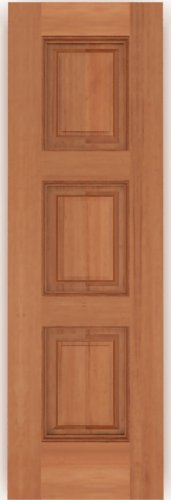
Custom Wood Doors -- Notes on Quality
We are often asked how our doors are different. This article
attempts to explain why our doors cost only a little bit more, but
look so much better and last so much longer. There is a summary
table at the bottom of the article for your reference, but we hope
the explanations help you to gain a better appreciation of the
anatomy of a door.
Estate Grade Custom Doors
Our Estate Grade doors are the best doors that money can buy.
These doors are crafted in the exact same way that doors were
made 200 years ago, when aesthetics, strength and durability were
the controlling factors. Double tounged feathered tenons in all
rails bigger than 8", deep pocket blind mortises, splined glue
joints in panels, deep profiles and elaborate sticking are all
hallmarks of our doors. And these doors are heavy and solid, so
they will last and last. They can survive knicks and dings,
refinishing, and rough treatment.
None of the easily detectible "cheap" construction methods are used
in our doors. The stiles are solid through and through, the grain
of the sticking matches the grain of the stile because it is not a
separate applied piece. The panels are deeply sculpted and raised
- not constrained by the limitations of MDF and vacuum pressing
ultra thin veneers over a particle core. When you look at these
doors, you can see deeply into the grain, and it makes sense -- there
are no splices, overlaps, or odd junctions of grain where veneers
meet and attempt to match (but don't really match).
The joinery is ultra strong, and although more expensive than the
inferior joinery methods like dowels, or unsightly screws and
anchors, Estate Millwork has made long strides in reducing the cost
of mortise and tenon joinery through automation. Where other door
manufacturers have elected to take the cost out of their products
by changing to a cheaper joinery method, we have left the method
alone, and taken the cost out with robotics. We know that mortise
and tenon joinery is the best because there are doors that are 600
years old and older made with this type of construction. The new
fangled doors are at most forty years old, and it is unclear how
long they will really last.
Premium Grade Custom Doors
Solid in every respect except the stiles, which are engineered
hardwoods (maple, poplar, or same species) with a thick 1/4"
veneer, these doors offer many of the benefits of our Estate Grade
doors, at a lower price. The panels are still solid and spline
jointed, the rails are solid, although the joinery is hardwood
dowel, rather than mortise and tenon.
Standard Grade Custom Doors
Estate Millwork does not manufacture doors at this level of
quality, but includes the information here for purposes of
contrast. No longer are the panels solid, but are veneered MDF,
often with a very thin veneer, perhaps 1/128 of an inch. This
veneering technique limits the visual appeal of the panels, as
well as constrains the type of profile that can be placed on the
panel. This type of door should only be used where aesthetics is
not a primary concern, and durability is not as essential.
The veneer, in addition to being highly susceptible to scratches
and dings, is also too thin to re-finish or even repair. In order
to drive the costs down as much as possible on these doors, other
manufacturers generally offer them in standard sizes only, with
limited or no customizations with respect to profiles, sticking,
rail placements or dimensions. These doors are often sold in the
box stores are "premium grade", but the poor joinery and the
limited visual elegance give them away.
Utility Grade
These doors are the cheapest that money can buy, and the ugliest.
In their worst incarnation, they are flush doors with a thin veener
just on the front and back faces (edges are not veneered). The
cores are mostly hollow, re-inforced with cardboard, or sometimes a low
grade foam, particle board. They will not withstand the test of
time, are very lightweight and are usually only used in the lowest
grades of construction -- budget apartments, basements, low-end
residential. Needless to say, Estate Millwork does not offer this
type of door.
| Grade | Price | Aesthetics | Joinery | Durability |
|---|---|---|---|---|
| Estate -
Solid Wood Stiles, Rails and Panels. Mortise and Tenon joints. | $800 | 
|
|
|
| Premium -
Solid Rails and Panels, Veneered Stiles. Dowel Joinery. | $700 | | |
|
| Standard -
Solid Rails, Veneered Panels, Engineered Stiles with
Composites. Dowel Joinery. | $400 | | | |
| Utility -
Composite Cores, Veneered Panels, Rails and Stiles. Dowel, Screw or Anchor Joinery. | $100 | | | |
Solid Wood Doors vs. MDF, Veneer & Composite Doors - Common Questions
What is the difference between a solid wood door and an MDF or veneered door?
A solid wood Estate Grade door has stiles, rails, and panels made from solid hardwood through and through, with deeply sculpted raised panels in which you can see into the grain. An MDF or veneered door presses a very thin veneer, sometimes as little as 1/128 of an inch, over a particle or MDF core. That thin veneer limits the panel profile, is highly susceptible to scratches and dings, and is too thin to refinish or even repair.
What is mortise-and-tenon joinery and why does it matter in a door?
Mortise-and-tenon is the traditional joint in which a tenon seats into a deep blind mortise, the strongest way to join a door's rails and stiles. It is why doors built this way can survive 600 years and older, versus newer dowel, screw, or anchor joinery whose real lifespan is unproven. Estate Millwork keeps mortise-and-tenon joinery affordable through robotics rather than switching to a cheaper joint.
Are solid wood doors worth the extra cost?
Solid wood custom doors cost only a little more than veneered or composite doors, but they look better and last far longer. They are heavy and solid, survive nicks, dings, refinishing, and rough treatment, and can be refinished for decades, while cheaper doors cannot be repaired once the thin veneer is damaged.
Can a solid wood door be refinished when a veneered door cannot?
Solid wood doors can be sanded and refinished repeatedly over their life. Veneered doors use a veneer often as thin as 1/128 of an inch that is too thin to refinish or even repair, so scratches and wear on them are permanent.
What grades of doors does Estate Millwork make?
Estate Millwork builds Estate Grade doors, which have solid wood stiles, rails, and panels with mortise-and-tenon joinery, and Premium Grade doors, which have solid rails and panels with a thick quarter-inch veneer on engineered stiles and dowel joinery. It does not manufacture Standard or Utility grade doors, which rely on veneered MDF panels and hollow or composite cores.